The session can be recreated using the file u_tables.sql (the script is at the bottom of the file) that is located in :
C:\Program Files\Microsoft SQL Server\MSSQL10.SQL2008\MSSQL\Install\
The session can be recreated using the file u_tables.sql (the script is at the bottom of the file) that is located in :
C:\Program Files\Microsoft SQL Server\MSSQL10.SQL2008\MSSQL\Install\
For those who may be starting out with query execution plans, it may be interesting to consider the use of Search arguments (SARG) in queries. The use of SARG has 2 objectives :The first query uses and index scan with the following cost :
If the filter is not a SARG then typically an index scan or table scan is performed on the entire table or index.
- Limit the number of rows returned by the query
- Use an index seek operation to improve the performance of the query
2 points to remember :
A simple Example using AdventureWorks2008:
- A filter expression is not a SARG if the column is used in an expression such as YEAR(OrderDate) or LEFT(Employee.Name,1)=’B’
- The use of the COLLATE operator on a column invalidates the use of and index on that column.
CREATE NONCLUSTERED INDEX OrderDateIndex ON Sales.SalesOrderHeader ( Orderdate )
GO
SELECT COUNT(*) FROM Sales.SalesOrderHeader sohThese 2 queries will generate the following Query plans:
WHERE YEAR(soh.OrderDate )
=2004
SELECT COUNT(*) FROM Sales.SalesOrderHeader soh
WHERE soh.OrderDate >= '20040101' AND soh.OrderDate < '20050101'

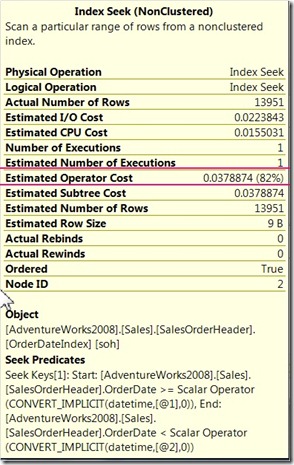
as you can see the second query plan cost is reduced by using a SARG in the query resulting in the use of the index seek operator, that allows SQL server to use a balanced tree to search the records.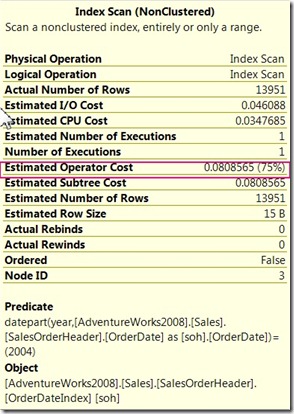
When tuning queries, one the first basic strategies is to minimize the use of joins. Additionally outer joins incur more cost than inner joins as they require extra work to retrieve unmatched rows.
TIP : If only inner joins are used , the ON and WHERE Clause behave the same. Consider the following queries:

you can see that the execution plans generated for both queries are the same:

If the queries would have been written with outer join, they would have different query plans.


